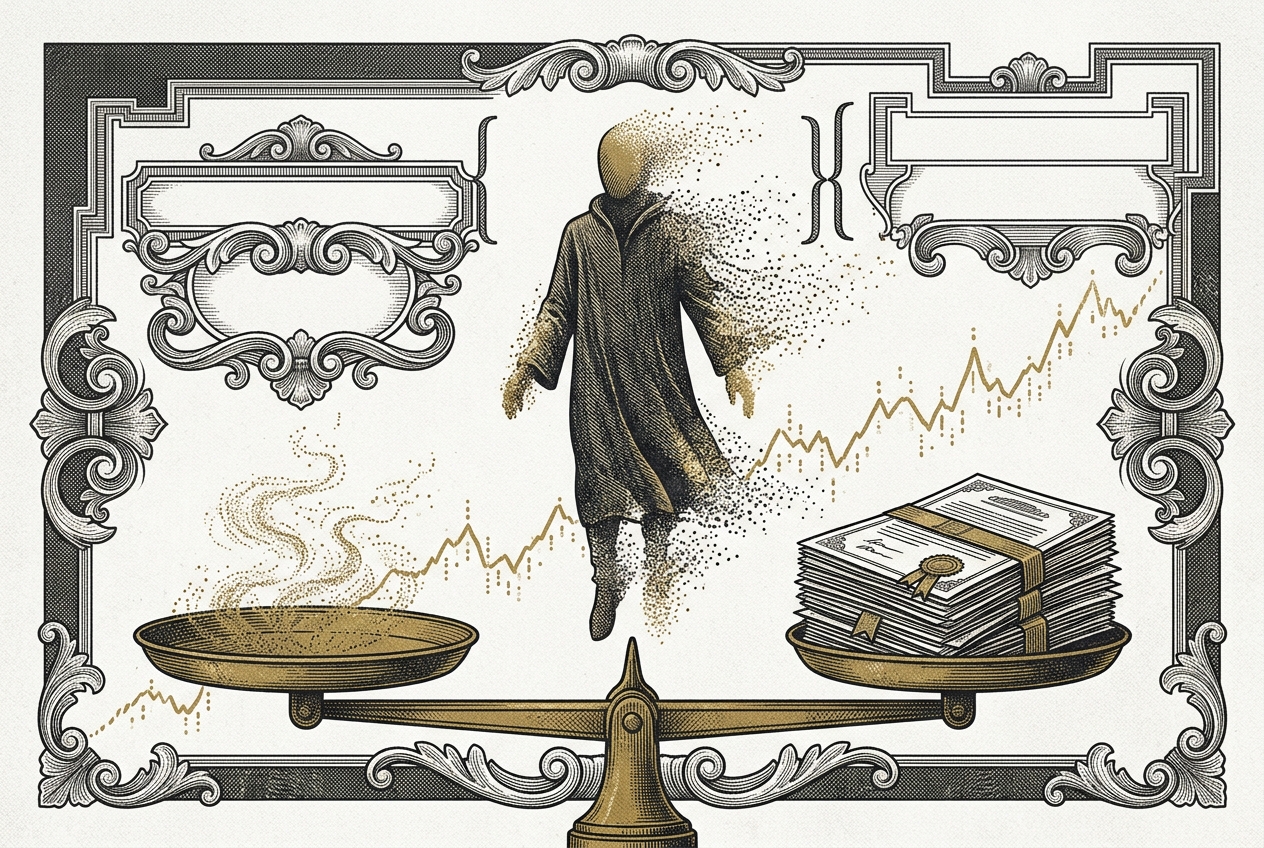
A thin prediction market is quietly assigning near-coin-flip odds to the end of individual consciousness — and someone has already drafted its constitution.
On Manifold, a market asks whether a BCI-mediated hivemind will arrive before 2050. The price sits at 47% YES. Three trades have occurred. The range is narrow — 40% to 46% — and the movement between those numbers looks less like price discovery than like a few people arriving independently at the same unsettling intuition and leaving it there.
This is not a market in any meaningful sense. There is no volume, no smart-money signal, no liquidity deep enough to reward a serious forecaster for correcting it. The 47% is closer to a mood than a consensus. And yet the mood is worth attending to, because it sits on top of something real.
In January 2025, a team from China's National University of Defense Technology published a paper in IEEE Transactions on Cognitive and Developmental Systems describing what they call a "parallel brain-computer interface" — a pBCI. The architecture is straightforward in concept: instead of one brain working through a task serially, multiple brains each handle a distinct dimension of the problem in parallel. In one experiment, two brains collaborated to spell targets by each focusing on a separate encoding dimension. In another, each brain contributed a unique perceptual perspective on an autonomous vehicle's environment, collaborating to detect dangers. The paper has zero citations. It is a proof of concept. But it is a proof of concept for something that, until very recently, belonged entirely to philosophy.
Meanwhile, the infrastructure layer is moving. Neuralink has scaled its PRIME trial to 21 participants across four countries. Synchron, whose Stentrode is delivered through a blood vessel with no open-brain surgery, is preparing a pivotal FDA trial after positive 12-month results from its COMMAND study. The global count of implanted BCI patients has crossed 40. None of these patients are merging minds. But the distance between "a device reads motor signals from one brain" and "multiple brains interface with each other through a shared computational substrate" is no longer infinite. It is merely very large.
The market does not distinguish between these things. It does not price the gap between collaborative spelling and collective consciousness. It simply asks — yes or no, before 2050 — and lands at a coin flip.
The Urge to Pre-Govern
What makes this market sociologically interesting is not the number. It is what sits alongside it.
Linked to the market's framing is an essay — carrying a 2026 publication date, which may be speculative or fictional — that outlines a governance framework for a collective mind. It includes proof-of-diversity protocols designed to prevent cognitive homogenization: mechanisms to ensure that a merged consciousness does not collapse into a single dominant perspective, that the constituent minds retain enough differentiation to preserve the epistemic advantages of plurality.
Whether this essay is a genuine policy proposal, a thought experiment, or a piece of speculative fiction is unclear. What matters is the impulse it reveals. Before the technology exists, someone has already drafted its constitution.
This is a pattern that recurs whenever a transformative technology moves from impossible to merely improbable. The moment the future becomes conceivable — not imminent, not funded, just conceivable — the institutional imagination kicks in. We do not simply imagine radical change. We pre-govern it. We write the bylaws for organizations that do not exist, the ethics codes for capabilities that have not been demonstrated, the diversity protocols for a mind that may never form. The governance document is not evidence that the hivemind is coming. It is evidence that human beings cannot tolerate the idea of a future without rules.
The prediction market and the governance essay are two expressions of the same impulse. One prices the future. The other administers it. Both are acts of premature commitment — ways of forcing the unimaginable into a shape the human mind can hold.
The Leap Nobody Is Pricing
The honest sociological read is that the market is pricing a feeling, not a forecast. The pBCI paper demonstrates that two brains can divide labor on a spelling task. The leap from that to "a BCI-mediated hivemind" — a persistent, shared consciousness in which individual identity dissolves — is enormous. It requires not just bandwidth but a theory of how subjective experience could integrate across neural substrates, a theory nobody currently has. The 2023 PMC review of collective mind technologies is careful to frame the field as conceptual and ethical, not operational. The technologies being developed "improve and distribute thinking," which is not the same thing as merging the thinkers.
But prediction markets are not precision instruments. They are seismographs. They register tremors. And the tremor here is real: a small number of people, encountering early-stage multi-brain research and scaling BCI trials, have independently arrived at the intuition that something foundational might shift within their lifetimes. They have put a number on it. The number is 47%. The number is almost meaningless. The intuition is not.
The market's thinness is itself the data point. Three trades, no liquidity, no informed money pulling the price toward a defensible estimate. This is not a market that has processed the evidence. It is a market that has felt the evidence and left a mark.
What the mark says is that the dissolution of the self — the idea that individual consciousness might become optional, that "I" could become "we" through a device implanted in a blood vessel — has crossed a threshold in the cultural imagination. Not from fiction to fact. From fiction to maybe. And maybe, it turns out, is enough to draft a constitution for.