In June 2026, the New York Times reported that Mark Zuckerberg is personally overseeing the development of a prediction market application internally called "Arena." The app, also codenamed Antwerp and FBForecast, is designed to let users bet—initially with play money, eventually perhaps with real money—on the outcomes of real-world events. Zuckerberg has simultaneously opened partnership talks with Polymarket and Kalshi, the two leading real-money platforms.
This is not Meta's first attempt. In 2020, the company launched an app called Forecast, a play-money prediction market that was quietly shuttered in 2022. What changed between then and now is not the technology. It is the cultural moment. Prediction markets emerged from the 2024 U.S. presidential election as a legitimised epistemic instrument—cited by journalists, trusted by traders, treated as a new category of truth-adjacent data. Zuckerberg wants to capture that cultural energy and feed it through the most powerful distribution engine ever built.
Betting as Conversation
The most revealing detail is not the app itself but Meta's internal framing. Ime Archibong, the Meta executive leading Arena's development, wrote in an internal post last month: "When markets are built into a personalized feed, they stop feeling like something for traders. They start to feel like part of the conversation that is tied to memes, moments, and whatever people are paying attention to."
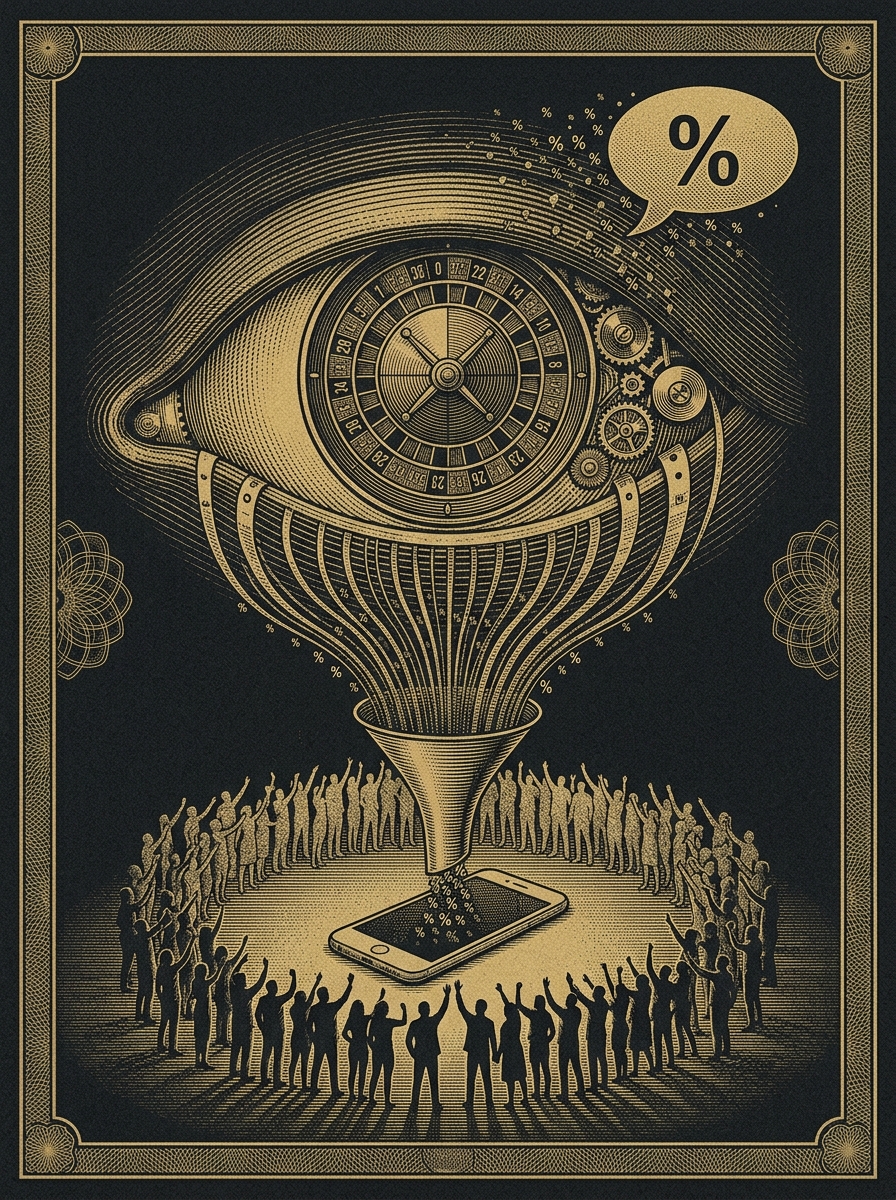
Read that sentence twice. The explicit strategy is to dissolve the boundary between a market—an instrument designed to aggregate information and price probability—and a social feed—an instrument designed to maximise engagement. These are not the same thing. They have opposite epistemic incentives. A market works best when participants are informed, dispassionate, and financially motivated to be right. A feed works best when participants are emotional, impulsive, and socially motivated to perform. Meta's plan is to fuse them.
The vision, as reported, extends beyond a standalone app. Meta wants to embed prediction markets into Facebook's news feed, into Messenger group chats, and into video content. Users would wager on political outcomes, cultural events, and trending topics generated automatically by Meta's Llama AI model, which will produce prediction questions from whatever is currently going viral. The social conversation, as Archibong put it, "is the payoff."
The Epistemic Monopoly
Here is the structural concern. Meta controls the social graph for over 3.6 billion daily active users. It controls what people see, what they discuss, and who they trust. If the same entity that controls the conversation also controls the market that prices the conversation's outcomes, you no longer have a market in any meaningful sense. You have a company that sets the agenda, hosts the discourse, and then quantifies that discourse's conclusions—all within a single closed loop.
This is what an oligopticon looks like when it matures. Not a panopticon, where a central authority watches everything. An oligopticon: a small number of nodes through which all observation must pass, and which can therefore shape what is collectively knowable. When Meta auto-generates prediction questions from trending topics, it is not merely reflecting public interest. It is selecting which questions are worth asking, framing them in Llama's language, and then letting its user base "price" them. The market output will be treated as signal. The market input will be a feed-engineered population.
The Population Problem
Prediction markets derive their value from the quality of their participants. Polymarket's user base, while imperfect, skews toward crypto-native traders, political obsessives, and people with actual capital at stake. The signal is noisy, but the participants have skin in the game. Kalshi, regulated as a derivatives exchange, has its own quality controls.
Meta's user base is the general public. The same population that drives engagement-driven outrage cycles, believes viral hoaxes, and has been shown to be susceptible to algorithmic emotional amplification. Introducing prediction markets to a feed of doomscrolling teenagers—Meta is explicitly targeting 18-to-34-year-olds—does not produce wisdom of crowds. It produces wisdom of feeds. The price of a contract on a Meta prediction market will tell you what the algorithm has decided to surface that day, not what informed participants collectively believe.
The Gambling Question
There is also the matter of what this actually is. Meta is, in essence, building a gambling product targeted at young adults and embedding it into their daily social infrastructure. Gambling disorder diagnoses have risen more than 60 percent since 2018 in U.S. states that legalised sports betting, with the largest increase among 18-to-29-year-olds, whose rate more than doubled, according to a 2026 Epic Research study. Meta's own internal framing—"the social conversation is the payoff"—describes, with startling precision, the mechanics of behavioural addiction: variable reward, social reinforcement, and the removal of friction between impulse and action.
The play-money framing is a regulatory strategy, not a product philosophy. Meta has not ruled out real-money wagering. And even in play-money mode, the psychological mechanics are identical: you predict, you win or lose, your friends see it, you are socially rewarded for being right. The currency is irrelevant. The loop is the product.
What Died in 2022
Meta's previous prediction market, Forecast, launched in 2020 and was killed in 2022. It failed because the cultural moment hadn't arrived. Prediction markets were a niche curiosity, not a mainstream epistemic category. The 2024 election changed that. Polymarket's volume during the election cycle made prediction markets a media fixture. Journalists started citing odds as if they were poll aggregators. The concept achieved legitimacy.
What Zuckerberg is doing now is not building a prediction market. He is building a distribution channel for prediction markets. The product is not Arena. The product is 3.6 billion people being conditioned to think about the future in terms of probabilities generated by a Llama model and priced inside a feed that optimises for engagement. The question is not whether Meta's prediction markets will be accurate. The question is whether accuracy was ever the point—or whether the point was to make "the markets say" the new "sources say."